

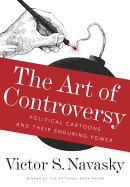
Caricatures have long been looked down upon by cultured journalists and practitioners of the "high arts." They inspire fear in politicians, provoke death threats from religious fundamentalists and can change public policy with their emotionally charged, voiceless rhetoric. Former Nation editor Victor Navasky's The Art of Controversy is a thought-provoking and intriguing discussion of how the "low art" of caricature got its bite.
Navasky takes a professorial approach in delineating the significance of the caricature and exploring how political content and imagery merge metaphorically in the brain to trigger a primal, emotional response. He cites the works of great artists from Thomas Nast to Ralph Steadman while advancing his own philosophical discernment of caricature's enduring power: "Perhaps the distortions and leanness with which most caricatures are rendered," he writes, "combine to form a hyper-charged, streamlined delivery vehicle for the ideas, arguments, narratives and associations they contain."
The delivery can be so effective that a Danish caricaturist who drew the prophet Muhammed was subject to mass condemnation and calls for censorship, even though most of his attackers had not seen the actual drawings. From this case, Navasky (Naming Names) argues eloquently and convincingly as to why censorship of caricature artists amounts to an assault on individual free speech.
The Art of Controversy is an amazing historical document from a political journalist all too familiar with caricature's intuitive and divisive power. --Nancy Powell, freelance writer and technical consultant