

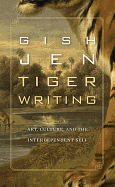
Gish Jen's elegant and wide-ranging Tiger Writing--a collection of the award-winning novelist's talks in Harvard's annual Massey Lecture series--explores the differences between Eastern and Western ideas of the self in fiction and culture, and why they matter.
When he was 85, Jen's father wrote a 32-page family history that began 4,000 years in the past, reflecting an Asian sense of connection to place and history and an interdependent idea of the self. By contrast, the Western notion of an independent self focuses on individual experience as the basis for observing and narrating the world. Jen synthesizes cross-cultural and cognitive studies with analysis of Western literature and other art forms to argue that the novel, which celebrates the truth of individual experience, could develop only in the West and expresses the core American values of individualism and exceptionalism.
Jen, the child of Chinese immigrants, loved novels because they were an "Outsiders' Guide to the Universe." She read to understand her context, not to see herself reflected on the page as her young American friends did. Both cultures influence her fiction, she writes, concluding that literary fiction is important because it can express either way of understanding oneself: "The novel knows much more than the person who wrote it."
The first edition of Tiger Writing is physically beautiful--printed on ivory paper with photos throughout, intimate in the hand and a pleasure to touch and hold. It seems fitting that a book about writing, connection and culture provides such a full sensory experience. It is a perfect metaphor for its contents. --Jeanette Zwart, freelance writer and reviewer