

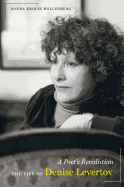
The poet Denise Levertov (1923-1997) is finally getting the biographical treatment she deserves. Less than a year after the publication of Dana Greene's A Poet's Life, Donna Krolik Hollenberg presents the comprehensive, in-depth A Poet's Revolution--an effort, she says, to "observe the connections between life and work in a way that illuminates the greatness of the major poems."
Levertov was born in England into many cultures: Jewish, German, Welsh, English. Well educated, she began writing poetry early. At 12, she sent some poems to T.S. Eliot for comment; he was encouraging. After her first book, The Double Image, was published in 1947, she married and moved to the U.S., where she came under the influence of such poets as Robert Duncan and Lawrence Ferlinghetti.
With her title, Hollenberg places Levertov's life in the right place, revolution--which the poet embraced as "the only word/ we have." Her poetry was filled with political and anti-war material; some felt it detracted from her art, but she kept at it until her later years when, after converting to Catholicism, her work took on a very religious, contemplative tone.
Hollenberg quotes extensively from the poems to show that Levertov's life was a "process of growth" personally and artistically. In the end, she points to the poem "Hymns to the Darkness" and its line about "embracing the dark." Levertov died in a Seattle hospital on December 20, 1997--the darkest night of the year. --Tom Lavoie, former publisher