

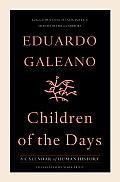
Uruguayan writer Eduardo Galeano (Open Veins of Latin America) has built his career by blending history, fiction and political analysis into a form that he describes as "obsessed with remembering." In Children of the Days, he compresses that obsession into a form modeled on the medieval book of days.
Instead of a typical "today in history" almanac, Children of the Days is a series of one-page responses to historical events, people and ideas--closer to riffs than essays--each tied more or less to a specific day of the year. Beginning with the reminder that January 1 "is not the first day of the year for the Mayas, the Jews, the Arabs, the Chinese or many other inhabitants of this world" and ending with the Hebrew meaning of "abracadabra," Galeano's compendium of facts is unabashedly multicultural. There's a strong bias in favor of historical anecdotes from Latin America, Africa and Asia, but he never romanticizes the non-Western world.
He celebrates not only well-known historical figures, but forgotten heroes and martyrs. He draws unlikely connections and ignores mainstream high culture, discussing the significance of Tarzan's howl at greater length than responses to major works of Western art. Some themes recur: lost libraries, new knowledge, old prejudices and daring acts of resistance to tyranny. Even when his subjects are familiar, Galeano's conclusions are always surprising. --Pamela Toler, blogging at History in the Margins