

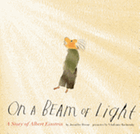
Author Jennifer Berne (Manfish) and artist Vladimir Radunsky form the ideal team to tell of the early childhood and late blooming of Albert Einstein.
With a minimum of text and artwork that moves smoothly between the abstract and the concrete, the duo demonstrates the way Einstein's mind also traveled fluidly between his imagination and setting down his ideas in a way that others could understand. Young Albert said nary a word until he turned three. When he was ill, Albert's father brought him a compass, and the boy's observations led to a breakthrough: "Suddenly he knew there were mysteries in the world--hidden and silent, unknown and unseen." The book's design also supports this transition. As Albert reads and wonders and learns, Radunsky fills the pages with swirls of colors and crossed-out formulas, alluding to the scientific process of trying hypotheses and eliminating theories that don't work. Enlarged phrases in red type give readers the gist of the major ideas Berne presents.
Most of all, the book awakens a sense of curiosity and mystery in youngsters. As Albert watches a lump of sugar dissolve in his tea, he wonders, "How could this happen?... How could one thing disappear into another?" This observation eventually leads to his hypothesis about everything being made of atoms. The book ends by posing to readers this very idea ("Questions that someday you may answer... by wondering, thinking, and imagining"), along with Einstein's main discoveries and a list of books for further reading. --Jennifer M. Brown, children's editor, Shelf Awareness