

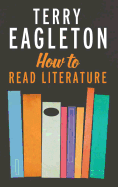
Terry Eagleton wrote the book on literary theory--Literary Theory: An Introduction--along with more than 40 other volumes about postmodernism, politics, ideology and religion. But don't be intimidated by How to Read Literature. This is no snoozy graduate school textbook. It's an accessible, thoughtful good read for those interested in the nuts and bolts of literature. It's an interesting peek behind the curtain of storytelling to reveal not only how it works, but why it works.
Focusing on various aspects of literature, including tone, plot and character, Eagleton reads deeply, providing commentary on a wide swath of literature we have come to know, love and sometimes revere--and now, through his insights, can know better. Take Joseph Conrad's Heart of Darkness. "As [Marlow] moves upriver into the centre of Africa he is also journeying deeper inside himself," Eagleton writes. "At the same time... he is traveling into the primeval past." Thus, he explains, "the narrative moves forward and backward at the same time."
Eagleton looks at Shakespeare and J.K. Rowling, Jane Austen and Charles Dickens, Evelyn Waugh and Samuel Beckett. As he picks apart the classics he delves into what makes literature good or bad and provides readers with the tools to analyze and interpret texts on their own. After reading How to Read Literature you'll be able to read any author--from Jack Kerouac to Judith Krantz--with a clearer understanding and a keener eye. --Jonathan Shipley, freelance writer