

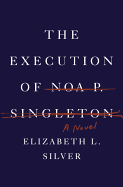
As titles go, Elizabeth L. Silver's The Execution of Noa P. Singleton is bluntly straightforward, and the directness continues as Noa introduces herself to us from death row in the Pennsylvania Institute for Women, where she's been sentenced after the murder of Sarah Dixon. Her guilt is never in question: "I know I did it," she says. "The state knows I did it, though they never asked why.... I was lucid, attentive, mentally sound, and pumped with a single cup of decaffeinated yellow zinger tea when I pulled the trigger. Post-conviction, I never contested that once."
And yet, six months before her scheduled execution, Noa receives a visit from Oliver Stansted, a British attorney, whose boss is Marlene Dixon, Sarah's mother--who petitioned the court vigorously for the death penalty at Noa's sentencing. Ten years later, though, Marlene has created Mothers Against Death, or M.A.D., in an effort to secure clemency for her daughter's killer.
At this point, the straightforwardness ends. It's clear from their initial conversation that both Noa and Marlene are holding back from each other--and from Oliver--and Silver dedicates the novel to exposing their secrets.
The Execution of Noa P. Singleton depends on Noa's strength as a character--and, to a lesser extent, Marlene's--to keep us caring long enough to get to the why of Sarah's death, and why Noa believes that she deserves to die. Why does she eventually allow Oliver to raise her hopes? What secrets is she taking with her to the grave? In her debut novel, Silver gives Noa a voice powerful enough to make us want to know the answers. --Ron Hogan, founder of Beatrice.com