

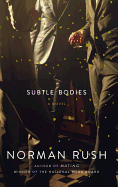
The sudden death of an old friend leads Ned, a political activist, to leave his California home for the funeral in the Catskills. Furiously pursuing Ned is his wife, Nina, who is trying to get pregnant and, currently ovulating, needs her husband. As Subtle Bodies, Norman Rush's first novel in a decade, begins, then, the main character flies toward death with a representation of life (or the potential for life) at his back. This sort of symbolism pervades the novel, which has the feel of an allegory ripe for decoding.
Douglas, whose accidental death sets Ned (and the plot) in motion, was the charismatic leader of a group of friends at New York University. It becomes apparent that Ned has always measured himself against Douglas, most sharply manifest in Ned's relationship prior to Nina with the beautiful Claire, once Douglas's lover.
In keeping with the highly cerebral nature of Subtle Bodies, Rush's characters appear to represent ideas. Ned, in Nina's mind, is a "secular Jesus," a role he tirelessly enacts throughout the book in organizing a rally against the war in Iraq. Ned spends the time leading up to Douglas's funeral attempting to convince his friends to sign a petition against the war. Nina may be Mary Magdalene--nurturing, unshakably loyal and strongly sexual. Meanwhile, Ned's long-lost friends (the apostles, perhaps?), now reunited, are each defined by specific qualities: the cynical intellectual, the faithful if rather simple-minded friend, the pragmatist. And as Nina and Ned investigate the past, the identity of Judas--a betrayal to which Ned blinded himself for years--is at last revealed. --Ilana Teitelbaum, book reviewer at the Huffington Post