

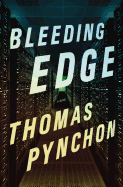
Spring, 2001: It's like post-Silicon Alley and the dot-com boom, it's computers, files, the endemic "bleeding-edge technology." Websites are popping up everywhere. It's robots.txt, rogue bots, transition matrix and hacker stuff. And there's the New York landscape, the "lawless soundscape of the midnight street, breakage, screaming, vehicle exhaust"--always too close, "part of the deal."
As Thomas Pynchon's Bleeding Edge begins, we meet Maxine Tarnow, a fraud investigator who has recently lost her license, but still is doing her own thing at her business, Tail'Em and Nail'Em, on New York City's Upper West Side.
Maxine becomes involved in a fraud case dealing with start-ups like hwgaahwgh.com and hashslingrz.com ("it's not code for a cheap diner"). But then the Benford curve anomalies, the ghost vendors and the Gulf-ward flow of capital rear their ugly heads. You dig? She's soon plunged deep into a cast of crummy characters a mile wide--and a screaming is about to come across the sky.
Amid all this computer chit chat, Pynchon tells Maxine's story in his very own natural, slangy vernacular, oozing with pop-culture references--Tetris, Friends, Picnic, Johnny Mnemonic and "Borderline"--one after the other. All the computer stuff might not work for some readers, but for those brought up in Pynchon's world, it will be literary manna. --Tom Lavoie, former publisher