

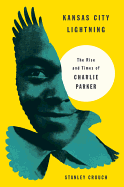
The controversial critic Stanley Crouch has worked for 30 years to complete his two-volume biography of saxophonist Charlie "Bird" Parker. The wait is understandable considering Crouch's output during this time: a dozen books, poetry, jazz criticism, television spots, NPR commentary and New York Daily News columns. In Kansas City Lightning, the first volume of his epic biography, he gathers interviews, news stories, early recordings and period photos and spins them with a novelist's touch into the story of Parker's journey from cruising the jazz clubs of "Boss Tom" Pendergast's wide-open 1930s Kansas City to 1940 Harlem, trying to jam his way into a full-time gig at Clark Monroe's Uptown House. When this volume ends, Parker is only 20 years old and already a father, a heroin addict and the genius who caused his fellow Midwestern musicians to marvel at his sounds, "devoid of vibrato, notes flying thick as buckshot, slapping chords this way and that, rambling quicker with more different kinds of rhythms than they'd ever heard from a saxophone."
The Charlie Parker of Kansas City Lightning is "lean as a telephone wire" and overwhelmed by his mother, Parkey, who raised him in a tough neighborhood. He doesn't care much for school; when it comes to learning to play like Roy Eldridge on trumpet or Buster Smith on alto, he schools himself. While Crouch spends considerable time describing Parker's young romance with Rebecca Ruffin and their marriage, parenthood and separation, the real romance of his early life came on the streets, where Kansas City provided plenty of dope, women and booze to musicians "who appeared free and drifting on a cloud of glamour, gifted with the ability to shape moods with sound." --Bruce Jacobs, founding partner, Watermark Books & Cafe, Wichita, Kan.