

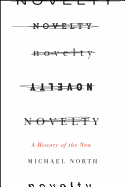
It is generally taken for granted that "newness" is a positive and necessary quality--yet where does this assumption come from? And why is it so easily accepted? In Novelty: A History of the New, Michael North dissects and deconstructs the notion of newness. Beginning with issues of why and how we have considered the new throughout history, North stretches this question to include the existence of newness itself. If everything comes from something prior, is the concept of novelty even possible? Can something truly be new, or merely a case of recurrence or recombination?
North's specialty as a scholar is 20th-century modernism (Reading 1922 et al.), but Novelty begins with the ancients, taking the reader from Plato up to the popular culture of the recent past. It's a rigorous analysis, but simplified in a digestible and entertaining manner. In his discussion of art, he points out that the distinction between modernist art and that which followed it was based on the possibility of novelty and associated qualities such as authenticity and originality. "All of these were blown away like so much dust, it seemed," however, "when Andy Warhol promoted some Campbell's soup cans from the supermarket to the art gallery."
As academic works should, Novelty pushes continually into the theoretical implications of its subject. It is not enough to consider novelty--we must consider why we consider it, and how. Consequently, Novelty is a challenging exercise in meta-cognition, one that will leave readers' minds feeling flexed and strengthened. --Annie Atherton