

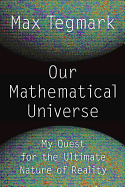
The quest to understand the mysterious universe likely began as soon as there was intelligent life on earth. In Our Mathematical Universe, MIT physics professor Max Tegmark delves into a mind-enriching cornucopia of past scientific discoveries and present theories concerning our state of existence--including the possibilities of multiple universes or multiverses. Through careful analysis of current research and some semi-mind-boggling leaps of understanding, Tegmark uses physics, astronomy and mathematics to show readers the complexity of the universe we see around us, while speculating about the ones we still can't see due to time and distance.
From the Big Bang to the more controversial "Inflation" theory, Tegmark explains in abundant detail how our part of the universe evolved to what we know today. Readers will take away a fair understanding of dark matter and dark energy, then proceed from the cosmic to the microscopic into the world of up quarks and down quarks, pions, kaons, tauons and W-bosons and Z-bosons, the building blocks of protons, electrons and neutrons. Quantum physics and quantum mechanics, "the illusion of randomness" and the deceptive qualities of time all play into Tegmark's theory that mathematics is at the root of our physical reality.
Although non-scientific readers may have trouble understanding some theories, the prose is generally accessible throughout and Tegmark's enthusiasm for the subject will keep readers intrigued, spurring them to reconsider the meaning and purpose of the heavens all around us. --Lee E. Cart, freelance writer and book reviewer