

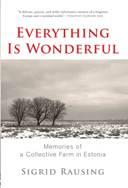
Sigrid Rausing spent a year on a collective farm on the west coast of Estonia in the mid-1990s, doing fieldwork for her Ph.D. in social anthropology. Her time there yielded an academic book, History, Memory, and Identity in Post-Soviet Estonia: The End of a Collective Farm. "Much as [that book] excluded the personal," she writes, Everything Is Wonderful "excludes the academic," containing Rausing's remembrances, after nearly 20 years, of time spent in an unusual cultural landscape and the questions that remain with her.
The tone of this slim memoir is quiet and unobtrusive; engaging in participation observation is the anthropologist's aim. Rausing contemplates the legacies of the Soviet Union in Estonia as a country and a culture, and in the village she lived in. As a parallel, she considers her own cultural identity as a Swede living in England who finds herself at home in a place where Estonian Swedes once made up a sizable and powerful minority, before the Nazis sent them to Sweden in a "perhaps overly collaborative" evacuation.
Rausing's subjects include the everyday tedium and alcoholism of a small village in a deeply depressed region; they include dream interpretations, and loving descriptions of natural settings, despite the monochromatic winter that occupies most of the year. Interactions with her neighbors and friends are rendered with an eye for irony. Yet for all its bleak detail, Rausing's work resonates with nostalgia as well. "I was tired, and often hungry," she recalls, "but even now, twenty years later, I miss those long quiet walks in that melancholy and restful landscape." --Julia Jenkins, librarian and blogger at pagesofjulia