

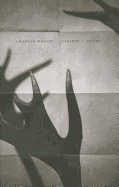
After many years, many books and many prestigious awards, Charles Wright seems to be asking himself in Caribou if there's anything left to say. The beautiful black-and-white cover design certainly has something to say, with its caribou antlers and their shadows laid over a plain background, looking like elegant fingers reaching up for something--but what? Do the poems provide an answer?
The 55 poems of Caribou are arranged in three sections, each full of feelings, thoughts and ideas. These are quiet and reflective poems, subtle and suggestive, carefully crafted, mostly short. Some of the titles ("Ancient of Days," "Long Ago and Far Away," "The Last Word," "I've Been Sitting Here Thinking Back over My Life") point to the book's underlying theme, while the last poem, "Translations from a Forgotten Tongue," confronts time, a night sky, the "other side," with a question:
"Under the push of our footprints,
the earth is ready for us.
Who knows how long this will go on?"
Wright tells us these are poems "written by someone who's spent his life/ Looking for the truth." He also tells us there isn't one "truth." Rather, these poems rejoice in a setting sun, autumn, the simple things of nature, a "slight wrinkle on the pond." As he writes in "So Long It's Been Good to Know You":
"The bat swoops over, listening for food.
It's starting to rain and I got to go home.
Be good,
See that my grave is kept clean."
--Tom Lavoie, former publisher