

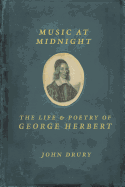
George Herbert, a Welsh-born Anglican priest in the 17th century, led a quiet life as a country parson. It was only after his death, at age 39, that his poetry came to light. In this biography, John Drury (also a minister) invites us in to see how Herbert lived and created some of the greatest religious poetry in the English language.
Like John Donne (Herbert's friend), he's probably one of those metaphysical poets you studied in school and have forgotten. Drury reads the poetry for today, demystifying its Anglican, devotional lyricism to highlight the way many of the poems are about love--love of God, yes, but love of others, of nature, too, making the poems more "universal," less "scriptural." He notes that Simone Weil, the French philosopher/mystic and political activist, thought Herbert's poem "Love III" the "most beautiful poem in the world": "Love bade me welcome. Yet my soul drew back."
Drury is good at demonstrating the significance of Herbert's playful and delightful use of new poetic forms, with some shaped as birds' wings or an altar. He points out that today, many popular church hymns draw their lyrics from Herbert poems, like "King of Glory, King of Peace." Composers such as Ralph Vaughan Williams and Benjamin Britten have set his poems to music. Join Dickinson, Emerson, Hopkins, Eliot, Auden and Bishop--all of whom appreciate the parson's work--in enjoying Herbert's poetry. --Tom Lavoie, former publisher