

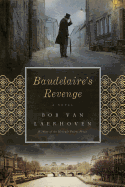
The poet's Baudelaire's work and life provide a rich, atmospheric background for Belgian novelist Bob Van Laerhoven's Baudelaire's Revenge--his first novel to be translated into English from his native Flemish and winner of the Hercule Poirot Prize for Best Crime Fiction (2007).
It's 1870. The Franco-Prussian War (which France eventually lost) has just broken out, and Paris is in chaos. Police inspector Paul Lefèvre, on his way to visit one of his favorite cocottes, hears a scream from a brothel. He finds the body of a man with an unusual tattoo; nearby is a sheet of paper with lines by Lefèvre's favorite poet, Charles Baudelaire--who himself died three years prior. Having once attended a reading by the "deathly pale poet," who signed a book for the detective, Lefèvre recognizes the handwriting as Baudelaire's own.
A second man, a writer, is found decapitated in a catacomb. The body was luridly, horrifically augmented after death to give it a female physical appearance. Another piece of paper with verse is found nearby--Baudelaire's handwriting again. When a third victim is found dead on Baudelaire's grave, Lefèvre has no choice but to believe the killer has a personal motive. Could the dead poet be seeking revenge?
Letters and journal entries inserted in the narrative help gradually fill in the gaps as Lefèvre closes in on the killer. This gritty, detail-rich historical mystery involves the reader in a subtle narrative web. Van Laerhoven weaves in some of this period's favorite supernatural elements--magic, exotic poisons, séances and ghosts--to create an eerie, fin-de-siècle atmosphere. --Tom Lavoie, former publisher