

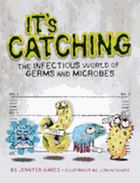
Author Jennifer Grady, senior scientist at the British Columbia Centre for Disease Control and a self-proclaimed "disease detective," uses an engaging voice to describe microbes in terms children can readily understand.
Some microbes act as agents of good, such as the funghi that makes bread rise (yeast or Saccharomyces cerevisiae) and mushrooms grow (Agaricus bisporus), and the mold used in penicillin. Others are harmless enough--until they see a way into your body, such as Staphholococcus aureus at the first sign of a cut, and E. coli (short for Escherichia coli 0157:H7) when it's ingested. These "unfriendly microbes" are called pathogens, or germs. In a chapter called "Get to Know the Great Germs!," Grady explains nine of the most common manifestations of germs (e.g., the common cold, influenza, food poisoning, rabies, etc.) tracked by the World Health Organization and displays each on a single card the way WHO would, including its common name, scientific name, transmission, symptoms and "DangerMeter." Because Grady frankly lays out the mortality caused by some of these, the book may be best read with an adult or kept for independent readers who will stick with the book long enough to see the antidotes in the following chapter, which discusses vaccines and antibiotics.
Clear flow charts and diagrams chart the information, while often humorous depictions of the bacteria inject some levity. Grady gives a balanced view of how to stave off and eradicate infection while also encouraging readers to maintain a healthy respect for the damage germs can do. --Jennifer M. Brown, children's editor, Shelf Awareness