

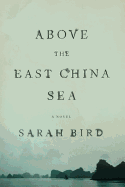
Framed in sections that mirror the days of Obon, a three-day Japanese celebration of the dead, Sarah Bird's Above the East China Sea asks its audience to suspend disbelief from the very beginning, when the ghosts of an unborn infant and its mother, Tamiko, begin to converse beneath the sea. Underpinned by Bird's authoritative knowledge of Okinawan history and military life (seen also in her novel The Yokota Officers Club), the novel jells the seemingly disparate stories of Tamiko, a World War II-era schoolgirl who took her life by plunging into the East China Sea as Okinawa burned behind her, and Luz, a present-day American whose mother is stationed in Japan.
Slowly, through both straightforward remembrances and dispatches from the spirit world, Bird reveals the full extent of her protagonists' losses: Luz's sister died as a newly enlisted recruit in Afghanistan, and Tamiko lost her entire world after the island was brutalized in the Battle of Okinawa. Luz's hallucinatory encounter with Tamiko's ghost sets her off on a quest to help send this aimless soul to the afterlife. On her travels, clutching Tamiko's lily pin--the emblem of a prestigious finishing school that became a wartime nursing program--Luz begins to unravel her own tormented psyche.
Every plot thread is carefully tied up, which makes conclusion feel a bit too tidy, but the saga itself proves worthwhile. This is a novel that asks a lot of its reader, but its rewards are equivalent, and as beautiful as the lily pin that catalyzes the whole adventure. --Linnie Greene, freelance writer and bookseller at Flyleaf Books