

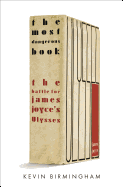
The Most Dangerous Book is striking not only for its intricate recounting of the arduous path Joyce's groundbreaking book followed to legal publication, but also for its history of the founding of Modernism and its literary biography of a giant in 20th-century literature. Kevin Birmingham, a Harvard lecturer in history and literature, has written a history that reads like a Dickens novel, telling a story of individual courage amid social disruption, a world where one dedicated writer takes on the machinery of centuries of rigid convention and censorship... and wins.
James Joyce's earthy, unconventional first fictional works found no conventional publishers until Ezra Pound championed them to a London magazine. With well-researched detail, Birmingham describes the destitute, alcoholic and sickly Joyce who filled scraps of paper with snippets of the words, phrases and structural outlines that gradually built his groundbreaking masterpiece. Like his other works, Ulysses ran first in magazines, so its notoriety spread well before it became a full book that could alarm censors. Birmingham carefully chronicles Joyce's 20 years of censorship before Random House founder Bennett Cerf and New York lawyer Morris Ernst finally took on the U.S. government in a 1933 precedent-setting case: The United States of America v. One Book Called Ulysses.
Cerf's and Ernst's success was built on the backs of many others, all honored here as Birmingham carefully details a hard-fought but conclusive victory against oppression that proclaimed "there was no absolute authority, no singular vision for our culture... towering over us." Given the current political milieu, it is a victory of which we should be strongly reminded. --Bruce Jacobs, founding partner, Watermark Books & Cafe, Wichita, Kan.