

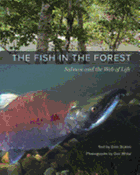
Seven species of salmon inhabit the Pacific in strikingly diverse ecosystems--ocean, river and stream, forest--in California, Alaska, the Bering Sea, Japan, Korea and Russia. Research oceanographer Dale Stokes calls these territories the "Salmon Forest" in The Fish in the Forest, a loving study of the salmon's place in our world.
Salmon may strike some readers as a potentially dull subject, but in Stokes's knowledgeable hands, the singular story of this fish is utterly riveting. Pacific salmon are anadromous and semelparous (born in fresh water, they mature in the salty ocean before swimming back up rivers and streams to breed just once and then die shortly thereafter); they possess an internal compass and map, enabling them to navigate over thousands of kilometers to the waterways of their birth; they are temporally aware, following a timetable for their reproduction and death.
Stokes presents a good deal of hard science (such as the complex cellular interchange of ions that allows them to survive in both salt and fresh water), but all of it is easily understandable. He explains why salmon are a keystone species; their feat of bringing rich marine nutrients well inland and at every point on a complex food web; and the interconnectedness of every resident in the Salmon Forest. Doc White's 70 color photographs are stunning, focusing not only on fish and forest, but also the species of wolf, bear and eagle that interact with the salmon.
Fans of the Pacific Northwest, trees, water and nature, and readers concerned with ecology or science, will find much to enjoy in this gorgeous and illuminating fish tale. --Julia Jenkins, librarian and blogger at pagesofjulia