

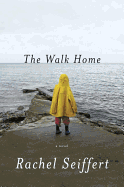
There are stories that scream and stories that whimper. Rachel Seiffert's The Walk Home somehow does both and neither--a mostly quiet narrative punctuated by moments of unrest. Set in the years following the Irish Troubles, the novel moves among three generations: Brenda, a middle-aged grandmother, and her brother Eric, the family's black sheep; Brenda's son Graham, who married Lindsey in the wake of an unexpected pregnancy; and Stevie, Lindsey and Graham's only son, whose childhood plays out amidst family tensions rising toward the boiling point.
Though the events unfold in Scotland, the family's Irish heritage simmers beneath the surface. When Eric, Graham's long-ostracized uncle, begins to discuss his biblical artwork with Lindsey, her initial response is tight-lipped. Slowly, Seiffert reveals that there are certain topics that are as explosive as bombs in this fictional world: religion, the past, the brutality of previous generations. Even without a full knowledge of this period, a reader will find enough breadcrumbs to follow. Seiffert's contextual hints are subtle, best detected in her characters: Lindsey's depression belies her disgust at the way old patterns replay, generation after generation, leaving familial fissures in their wake; Stevie's wary interactions with neighborhood boys prove his canniness is evolutionary, protecting him against foes that might attack at the sight of a symbolic patch sewn on his jeans or the mention of a last name. In the low-income setting, allegiances are built on dead relatives and everlasting grudges. For a novel so quiet and spare, The Walk Home's aftershock is formidable and eerie, akin to the pause after a moment of startling violence. --Linnie Greene, freelance writer and bookseller at Flyleaf Books