

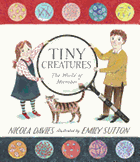
For curious minds and budding scientists, this introduction makes the giant job of minuscule microbes understandable and fascinating. The work of a microbe may be good or bad, from a human perspective, as author and artist aptly demonstrate.
In Emily Sutton's illustration on the title page, two siblings sail on the sea with their cat while a school of small fish swims below. "You know about big animals, and you know about small animals..." begins Nicola Davies's (Outside Your Window) text; a killer whale dwarfs the boat, and above the horizon an ant walks on a tree limb. Everything gels with a turn of the page: "but do you know that there are creatures so tiny that millions could fit on this ant's antenna?" The ant's antenna is enlarged "as big as a whale" so that readers can see the microbes residing there. "Right now there are more microbes living on your skin than there are people on Earth," Davies tells us, followed quickly by a "Don't worry!" and an explanation of how microbes residing inside and outside of our bodies keep us well. The book gives examples of the different shapes and sizes of microbes, and their role in breaking down food into compost and milk into yogurt.
Brother and sister model how germs ("the wrong kind of microbes") make you sick and how to "stop them from getting in." This is a fine introduction to a microscopic world. Those who wish to know more may enjoy It's Catching by Jennifer Gardy. --Jennifer M. Brown, children's editor, Shelf Awareness