

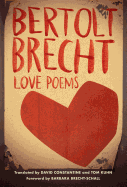
To many, Bertolt Brecht is famous as a playwright. But as the translators of this new collection of Brecht's Love Poems, David Constantine (a poet himself) and Tom Kuhn (editor of Brecht's writings), point out in their introduction, he's a great poet--"one of the three or four best in the whole of German literature." In all, Brecht wrote approximately 2,000 poems and songs. Two of his best known are "Alabama Song" (made popular by the Doors' version on their debut album) and "Mack the Knife" (which he wrote for The Threepenny Opera and was later sung by Bobby Darin, Ella Fitzgerald, etc. etc.)
Constantine and Kuhn note Brecht's output, the various topics he covered and his technical virtuosity in every form. Like Goethe, Brecht was a poet driven by Eros--he was always more or less in love, and these poems capture that. His early poems could be extremely sexual, mixing beauty and sin. "Baal's Song" references "a well-stacked woman" while the brief "O You Can't Know What I Suffer..." says much about the youthful poet's sex life: "O you can't know what I suffer/ When I see a woman who/ Sways her yellow silk-clad bottom/ Under skies of evening blue."
Brecht often uses his poetry to persuade, seduce; it's never sexist, just earthy and alive. Even in his final years, he was writing love poems. As Brecht's daughter Barbara Brecht-Schall writes in the foreword, "Papa always went back to his poetry." The translators are to be thanked for bringing attention to these otherwise forgotten gems, both naughty and nice. --Tom Lavoie, former publisher