

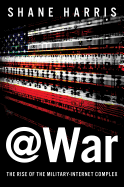
Shane Harris (a senior writer at Foreign Policy magazine) follows his unnerving and prize-winning book The Watchers with a similarly discomfiting study of the current state of the United States' ever-growing efforts to fight the next major war--a cyberwar potentially equal to nuclear war in its threat to the global electronic infrastructure that supports everyone from farmers to Wall Street financiers. With a cast of characters straight out of contemporary spy thrillers, @War untangles the many acronym-laden agencies and their "inscrutably" named initiatives and presents a history of the American government's fifth dimension of warfare (after land, sea, air and space).
In addition to the well-known NSA, CIA and DHS umbrella agencies, Harris explores their more clandestine special surveillance groups, like the NSA's elite hackers, TAO (Tailored Access Operations); RTRG (Real Time Regional Gateway), a kind of "Google for the new soldier-spies"; and DITU (Data Intercept Technology Unit), the FBI's version of the NSA's SIGINT (Signals Intelligence). He describes the numerous U.S. defensive and offensive cyber operations with code names like Pinwale, Nevershakeababy, Starburst, Buckshot Yankee and Stuxnet--the latter a computer worm designed to disable Iranian nuclear reactors.
In this very lively overview of the fifth dimension of war, Harris suggests that cyberspace should be managed like any other potential battlefield, where civilian-directed military oversight of its myriad pieces would serve us better than the current hodge-podge of public/private data collecting, spying and hack-attacking. In Harris's view, we don't need an Edward Snowden to expose the reach of the combatants; instead, we need a unified approach to prevent and contain the inevitable conflict. --Bruce Jacobs, founding partner, Watermark Books & Cafe, Wichita, Kan.