

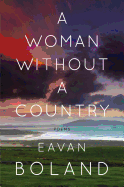
Among Irish poet Eavan Boland's descriptions of her ancestral landscape lies a central conflict of identity that hinges on a quote from Virginia Woolf's Three Guineas: "The outsider will say, 'in fact, as a woman, I have no country.' " Boland, who splits her time between Stanford, Calif., and Dublin, Ireland, searches unrelentingly for the space to which she and other women can lay claim, one outside the confines of history and geography.
Boland gives voice to a range of women, including her grandmother, who died in 1909 at 31, leaving five children, and her mother, as stoic and weathered "as if she had been made out of elm." In "The Wife's Lament," a 10th-century poem that Boland translates from its original Old English, the speaker is an abandoned woman whose lord has left, instructing her to "be still/ Stay here. In this place./ ...penniless, friendless...." While much of this collection focuses on grieving and grievances, these poems are anything but one-note. Suffering is merely one side of the coin, and she describes the other elements of womanhood just as artfully. In "Talking to My Daughter Late at Night," a mother recalls the rituals of her grown daughter's childhood bedtime. She muses, "The world is not stern, after all. Paper birds/ Are folded and fly off in the playground."
The most enchanting books convey urgency, a thought that needs to be voiced. A Woman Without a Country succeeds, and its combination of insight and candor proves that Boland's works belong alongside that of her legendary Irish predecessors. --Linnie Greene, freelance writer