

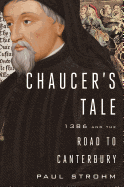
Annus mirabilis--"year of wonders"--is a time when important events occur. For Geoffrey Chaucer, that time was 1386, so argues medieval literature scholar Paul Strohm (England's Empty Throne) in his sparkling Chaucer's Tale: 1386 and the Road to Canterbury.
That particular year was one of crisis for Chaucer. He had already written more than half of the poetry he'd ever compose, enough to establish him as "the greatest English author before Shakespeare." Previously, he had a secure government job as a controller in the wool business, a nice apartment in London and security within the monarchy; he had been elected a Knight of the Shire, which gave him status and privilege. But for a variety of political reasons, in 1386, at the age of 43, Chaucer lost his job and home, and his marriage to Philippa was on the rocks (she would die a year later). Financially ruined, he retreated to Kent, adrift.
What was it about his character and his life that made it possible for him to create The Canterbury Tales? Strohm the literary detective works his wonders answering this question. From hundreds of scraps of information, a deep knowledge of the period and a bit of intuition, the biographer reconstructs Chaucer's life up to the creation of his masterpiece. The epic poem started with a mixed company of pilgrim tale-tellers. From this notion issued forth the work: "serial, multivoiced, stylistically mixed, many-themed." Strohm's meticulously researched, beautifully rendered mystery ends when the capacious life of the eventual founder of English letters is fully revealed. Annus mirabilis indeed. --Tom Lavoie, former publisher