

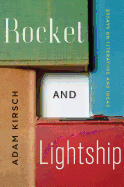
Though he's not yet 40, on the strength of the 19 essays collected in Rocket and Lightship, Adam Kirsch (Why Trilling Matters) qualifies as one of our most important working critics. Whether he's writing about literary classics or his contemporaries, Kirsch matches erudition with a generous, sympathetic spirit to produce criticism that's consistently wise and enlightening.
Kirsch intends that his essays "engage with texts at the point where literature intersects with society and history." That approach emerges explicitly in several pieces, including two that focus on Charles Darwin and two others that confront the theories of Francis Fukuyama, author of The End of History and the Last Man. Several essays are devoted to Jewish writers, and Kirsch is especially incisive in deconstructing Cynthia Ozick's "complicated engagement" with Henry James. He offers provocative insights into the theme of Jews and Jewishness in the oeuvre of Marcel Proust, whose mother descended from German Jews and who "moved in a milieu that was extensively, if not exclusively, Jewish," but he is equally proficient in dissecting the work of writers who don't share his religious heritage.
Simply listing the range of some of Kirsch's other topics--the sexual identity of E.M. Forster, the tensions between the inner lives and the criticism of writers like Alfred Kazin and Susan Sontag and the psyche of present-day Europe as revealed in the works of novelists Michel Houellebecq, W.G. Sebald and Ian McEwan--suggests the breadth of his concerns. Rocket and Lightship highlights the virtuosity of a keen thinker, someone intent on challenging our preconceptions while welcoming us to an intellectual feast. --Harvey Freedenberg, attorney and freelance reviewer