

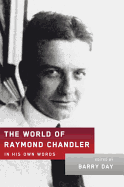
Though born in Chicago, Raymond Chandler was raised in England, so when he returned to the United States at age 24 he felt foreign. He had to learn what he called the "American" language, but conquered it in writing The Big Sleep, The Long Goodbye and many short stories in the noir style--a style he helped perfect. He created the archetypal hard-boiled private investigator Philip Marlowe and wrote screenplays for Double Indemnity, The Blue Dahlia and Strangers on a Train. When he died in 1959, he left a variety of written works behind, and many are respected as classics today. In The World of Raymond Chandler, editor Barry Day (The Noël Coward Reader) compiles Chandler's published and epistolary writing to form a picture of the man behind Marlowe.
Rather than a narrative told in Chandler's words, this is a collection of quotations. Selecting from letters and articles, but more often from Chandler's fiction, Day patches these fragments together with commentary into chapters on themes or common topics of Chandler's work: cops, dames, Los Angeles, Hollywood. Day makes the argument that Marlowe's voice represents Chandler's, particularly in their later years, as both softened (but not, Chandler insists, mellowed) until Marlowe in The Long Goodbye was "as hollow as the spaces between the stars."
What Day calls the master's "ground rules" are treasures, including "The mystery must elude a reasonably intelligent reader" and (sadly) "The perfect mystery cannot be written." At the end of this admiring collection, Day's reader is left wondering if Chandler came closest. --Julia Jenkins, librarian and blogger at pagesofjulia