

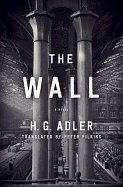
The life and work of the German writer H.G. Adler (1910–1988) was relatively uncelebrated in the U.S. until W.G. Sebald published Austerlitz in 2001. Sebald wrote in detail about the German concentration camp Theresienstadt, drawing much of his material from Adler's nonfiction book about the camp--Adler was imprisoned there for more than two years and also survived Auschwitz and two labor camps near Buchenwald. This renewed interest in Adler led to the English translation and publication of his first novel, Panorama, the beginning of what has come to be known as the Shoah trilogy, followed by The Journey. Now, with The Wall, all three novels are finally available in English, thanks to translator Peter Filkins who has been at this monumental project (all 1,500 pages of it) for many years.
Like Adler's two previous novels, The Wall is about memory, the Holocaust and bearing witness. Arthur Landau, a Holocaust survivor who now lives in a town like London with his second wife and two children, is coming to grips with his memories and his nightmares. After losing his first wife and family in the war, he's now trying to survive on little money while he writes his Sociology of Oppressed Peoples. His first-person narration goes on for 600 chapterless pages, switching between a stream of consciousness, dreams, what might be imagined and what is actually happening. Adler brilliantly details a tortured man trying to deal with his survivor's guilt and the "wall" to his past he can't seem to breach. --Tom Lavoie, former publisher