

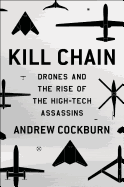
Journalist Andrew Cockburn (Rumsfeld) explores the U.S. military's dubious obsession with automated warfare in Kill Chain: The Rise of the High-Tech Assassins. It began during the Vietnam War, when a then state-of-the-art intelligence gathering system was deployed along the Ho Chi Minh Trail in Laos to stop the North Vietnamese from infiltrating South Vietnam. Operation Igloo White dropped billions of dollars of seismic, acoustic and chemical sensors onto the trail, triggering airstrikes whenever the North Vietnamese Army was detected. Unfortunately for the United States, the NVA quickly learned how to trick the sensors, sending bombs mostly into empty jungle or onto indigenous people.
True drone warfare required Information Age technological advances unavailable before the wars in Afghanistan and Iraq. Until those advances were possible, the United States military used conventional weapons systems in their strategic assassinations. South American cocaine kingpins became prime targets, and their deaths were touted as drug war victories. However, Cockburn shows that killing kingpins only made cocaine more available in the U.S. by creating competition among new upstarts. This pattern has repeated itself in Afghanistan, where the assassination of Taliban elders created a younger, more reckless, far deadlier generation of jihadi leaders.
Underpinning these strategic blunders is an infuriating history of corruption and collusion among politicians and private arms manufacturers, often at the expense of taxpayers, soldiers burdened with subpar weapons and civilians identified as militants by cameras with resolutions equivalent to legal blindness. Kill Chain is an engagingly written revelation of the well-hidden horrors and political farce behind the U.S. drone program. --Tobias Mutter, freelance reviewer