

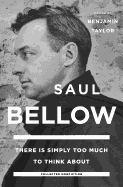
Saul Bellow lived in rarefied air for American writers--he won the Nobel and Pulitzer prizes and three National Book Awards (the only writer to do so). This year marks the centennial of Bellow's birth, a perfect time to publish a collection of his nonfiction, and Benjamin Taylor, who edited Saul Bellow: Letters, is the ideal person to take this on.
There are 57 pieces, from 1948 to 2000: essays, critical and autobiographical pieces, lectures, interviews and speeches. They deal with Chicago, past and present--Bellow was a "child of immigrants who grew up in one of Chicago's immigrant neighborhoods"--his Jewish heritage and Jewish writers; and his concern over the state of the novel, its past, present and future.
Bellow started out as a leftist, but as he grew older he became more conservative, concerned with the viability of civilization (another common topic for his analysis) and the poor state of "high culture" in America. For him, the most important element in a novel (that "latter-day lean-to, a hovel in which the spirit takes shelter," as he described it in his Nobel Prize acceptance speech) was the "stature of characters." Bellow frequently commented on the absence of such in modern literature.
Taylor has done a great job bringing all these pieces together, though a short introduction or brief paragraphs to situate the pieces would have been welcome. Nonetheless, There Is Simply Too Much to Think About provides us with a fine portrait of the artist. --Tom Lavoie, former publisher