

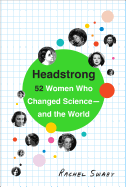
When freelance journalist Rachel Swaby (Wired, Runner's World) read a New York Times obituary about rocket scientist Yvonne Brill that began, "She made a mean beef stroganoff, followed her husband from job to job, and took eight years off to raise three children," she realized how skewed coverage was for women in science, where accomplishments are too often framed in the context of domesticity and marital status. Swaby's response is Headstrong, compact profiles of 52 women who made critical contributions to science and technology.
She describes how Rachel Carson's research into environmental toxins became the driving force behind the Environmental Protection Agency; how female doctors (Helen Taussig) founded the field of pediatric cardiology and developed a test for assessing newborns (Virginia Apgar); how female scientists deduced the orbital theory of electrons (Maria Goeppert Mayer), nuclear fission (Lise Meitner) and the helical structure of DNA (Rosalind Franklin) and coaxed added payloads from chemical propulsion systems (Brill). And actress Hedy Lamarr co-invented a secret communication system that would develop into wireless communications.
Swaby highlights the obstacles these women faced in dealing with their male counterparts, often working for peanuts to stay in the game, and the difficulties they continue to confront in a world where only 15% of women major in the sciences, even though in high school, girls take as many math and science courses as boys.
"If we treat women equally as scientists," writes Swaby, "we can introduce a new generation of chemists, cardiologists, mathematicians while revealing a whole hidden history." What a gift this would be for the next generation. --Nancy Powell, freelance writer and technical consultant