

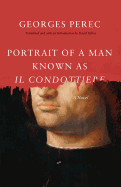
French author Georges Perec is best known for his daring experimental novels, such as The Void, which doesn't contain a single word with the letter "e." A noted lover of puns and puzzles, he has written the vast majority of his work under self-prescribed restrictions, forcing him to think with strategies few authors ever consider. In light of this reputation, Portrait of a Man Known as Il Condottiere initially seems out of place, telling a rather straightforward story. But fans of Perec will see many of the author's tics in his first novel.
Discovered by translator David Bellos decades after Perec's death in 1982, Portrait of a Man follows art forger Gaspard Winckler as he escapes the house of his patron, whom he has murdered. Winckler is suffering an existential crisis about his career as a con man, forcing him to reckon with his life up to that point. While Perec creates suspense as to whether Winckler will escape, Portrait of a Man has more in common with Fyodor Dostoyevsky's Notes from Underground or Albert Camus's The Stranger than a thriller. Told in first, then second person, before switching to a dialogue midway through, Portrait of a Man is a continually unstable narrative, where the main character is not only unreliable to the reader, but to himself. Never sure of his own intentions, Winckler proves a fitting, if frustrating, character study on identity, both forged and otherwise. --Noah Cruickshank, marketing manager, Open Books, Chicago, Ill.