

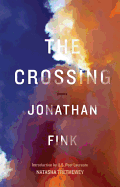
In the titular poem of his debut collection, The Crossing, Jonathan Fink writes of wandering souls, "To enter back into their forms, they wade/ into the body's sleep, descending thigh/ to chest: the match of throat, then mouth, then breath." Briefly, mind and body unify; the dream-state meets the sleeping form, and there's an awakening. Such are these poems, which capture moments personal and historical in the amber of Fink's economical lines.
Few collections invite a reader to luxuriate like The Crossing. Perception and reality underpin many of Fink's poems, which include an account of high school bullying and an 18-part poem about the 1911 Triangle Shirtwaist fire. In such competent hands, the book's varied topics--a meditation on Leonardo da Vinci's Vitruvian Man, a restaurant peopled by oil-field roughnecks--feel not only cohesive but visionary. The threads Fink weaves between worlds past and present, real and fantasized, are as palpable as they are prescient. All of the poems share, as Natasha Trethewey writes in her introduction, "precision of language, clarity, and the quest for beauty."
The best poetry is often signified by what's absent--misplaced words, jarring shifts, inconsistencies. The Crossing is a collection into which one submerges, rapt, as in a dream. --Linnie Greene, freelance writer