

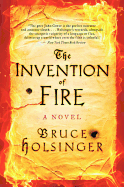
Bruce Holsinger's A Burnable Book introduced readers to unlikely medieval detectives John Gower and Geoffrey Chaucer. Fans will be pleased to know that the sequel, The Invention of Fire, revisits 14th-century London a year later, as the intrepid scholarly sleuths ply their deduction skills again.
The book opens on a night scene of a gong farmer and his son working by lantern-light to clean the muck of human excrement that has clogged up at the Long Dropper privy, next to the Thames. They come upon a "mound of ruined men," all dead. The next day, the renowned and well-connected poet Master Gower is summoned to the Priory of St. Bartholomew to look at the 16 bodies. A surgeon cuts into the back of one man to extract a "spherical object about the diameter of a half noble." These men, he tells Gower, were shot with a "handgonne." It's a word new to Gower but one that would "shape and fill the weeks to come."
Gower visits his good friend Chaucer to ask if he might have heard about a group of strangers who recently came to London, and then learns about the recent sighting of a party of Welshman. Could those be the men who met their fate in the privy? Who killed them and why?
The game is afoot, and Gower is a learned guide to all things medieval, a world Holsinger brings to life with period language (wherry, groats), which adds a fascinating layer of believability. Holsinger's medieval mystery featuring two famous writers succeeds on every level and will have readers hoping for more. --Tom Lavoie, former publisher