

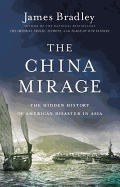
In The China Mirage: The Hidden History of American Disaster in Asia, James Bradley (Flyboys) unleashes a blistering critique of the Roosevelt presidencies' engagement with China.
According to Bradley, United States foreign policy in Asia grew out of economic imperialism, missionary zeal, ignorance and diplomatic duplicity in the opium trade (through which Franklin D. Roosevelt's maternal grandfather, Warren Delano, profited heavily). As American missionaries settled in China, they sought to create a China in the image of their homeland and ignored the political and cultural traditions of their host countries. By presenting Westernized, "democratic" ideals that Americans could easily accept and digest--a mirage that Bradley describes in detail--Harvard-educated officials from both Japan and China charmed billions of dollars in aid from the U.S. to support dictatorial regimes, helping Japan's occupation of Korea during Theodore's presidency and Chiang Kai Shek's civil war against Mao Zedong's growing Communist movement during FDR's administration. This led to similar doomed approaches in Korea and Vietnam, leaving Bradley to conclude that "American misunderstanding of China caused the nation to support Southern Methodist [convert] Chiang, bring on a world war that didn't have to be, oppose the bandit Mao, and go on to fight two bloody Asian wars."
Bradley's critical analysis is engaging and, like most of his nonfiction, affected by the wartime experiences of his father, one of the flag raisers on Iwo Jima: "I don't want my son in boot camp like his grandfather and uncle simply because of more misunderstandings between the Pacific's two great powers." --Nancy Powell, freelance writer and technical consultant