

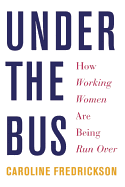
Since Sheryl Sandberg's 2013 book, Lean In, much of the conversation around women in the workforce has centered on women taking charge of their work--or opting out of it. But these conversations fail to account for the vast majority of women who don't have that choice: they work because they must in order to survive, or they stay home to care for children because childcare is cost-prohibitive. Caroline Fredrickson's book, Under the Bus, is a study of this class of working--or not working--women in the United States, providing an important perspective in what is often falsely seen as a binary argument: Sandberg's push to "lean in" versus Anne-Marie Slaughter's observation in The Atlantic that women can't have it all and must "opt out" of opportunities.
Frederickson, president of the American Constitution Society, starts Under the Bus with important historical context, providing a brief background on the labor laws of the United States today. "A confluence of factors," she argues, "including race, ethnicity, immigration status, and gender, has put an array of workers beyond the protections of the law." She then argues that current laws have disproportionately harmed women--particularly women of color--and resulted in unfair wages, loss of benefits and a distinct lack of support for those women who choose to have children.
Much of Fredrickson's argument is data-heavy, but Under the Bus is never dry. Instead, this collection of numbers and anecdotes serves to illustrate how far systemic policy change could go in creating equal opportunity across the board--improving working situations for women (and men). --Kerry McHugh, blogger at Entomology of a Bookworm