

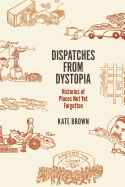
In the first essay of Kate Brown's Dispatches from Dystopia: Histories of Places Not Yet Forgotten, she writes about standing on a low hill in the Ural Mountains, where she puts one foot in Asia and one foot in Europe. Likewise, Brown's book masterfully straddles the line between personal travelogue and academic research. Her essays jump from a war-torn region of Central Asia to a forgotten hotel basement in Seattle, and Brown (Plutopia) argues that history is much better served by historians who put themselves in the places they research and the essays they write.
"Why, in disciplines that aspire to verifiable truth, do scholars sustain the fiction, when researching and writing, that they are not there?" she asks in her introductory essay. By situating herself in the physical place she studies, and within the writing that is born from the experience, Brown reports details other academics would pass over.
In "History (Im)possible in the Chernobyl Zone," she arrives in Ukraine to find that her source has been an online persona with no actual expertise. Brown then wanders the streets alone, attempting to uncover historical facts ignored by people traveling to Chernobyl for its post-apocalyptic imagery. From a cliff above Billings, Mont., in "Gridded Lives," she accounts for the similar physical and political utilitarianism between an oil-boom town's street grid and the factory zones of the former Soviet Union.
Historians, Brown says, often adopt a voice that speaks of a place as long-gone. While major events in these places have come and gone, Brown wants her readers to remember that the places themselves still exist. --Josh Potter