

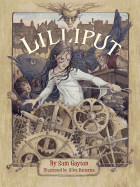
In a funny, bittersweet follow-up to the classic Gulliver's Travels, Sam Gayton imagines a return to Lilliput from the point of view of one of its citizens.
Lily is out crabbing with two friends when she sees a giant rising from the sea, "climbing out of all the stories Nana told her at bedtime." The giant, Lemuel Gulliver, kidnaps Lily and takes her back with him to London to live in a bird cage in the attic of a clockmaker's shop. Then one day, Finn the clockmaker's apprentice comes to her rescue. The author makes the most of the contrast in size between the diminutive Lily and the "Yahoos" (her name for the human giants, borrowed from Jonathan Swift's 18th-century novel) who run the world around her. Gayton adds an original spin with his concept of time as the true enemy. For Lily, "one moon," or month, is equivalent to a year for a giant. Villainous Mr. Plinker's clock creations embody these ideas. His pièce de résistance is the "Waste-Not Watch," affixed to Finn's wrist; for every second Finn "wasted," the watch tightened. Lily "learned that the world was full of cages, and not all were built of iron."
Readers get a rare view of London from the gutter up, with all its sights, smells and sounds, and artist Alice Ratterree captures the characters and their surroundings in impressive detail. An image of Lily inside Plinker's Astronomical Budgerigar, attempting to free the bird that will fly her to freedom, is one of the book's highlights. --Jennifer M. Brown, children's editor, Shelf Awareness