

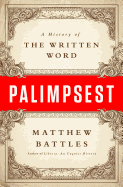
Matthew Battles (Library: An Unquiet History) undertakes a mammoth topic with Palimpsest: A History of the Written Word. Rather than an exhaustive chronicle, however, he has composed an extended meditation, a roaming through the centuries. The result is a collection of narrative examinations of writing as a technology, as a means of wielding power, as artistry and as communication. As Battles quotes it, the Oxford English Dictionary defines a palimpsest as a "writing surface on which the original text has been effaced or partially erased, and then overwritten by another." His imagination is captured by this concept in fact and as metaphor, and Palimpsest is in part a drawn-out consideration of "mind as page" and "page as mind" (the titles of its opening and closing chapters).
Among other revelations, Palimpsest elucidates the original meaning of "pirated" literature: "not... the unauthorized reproduction of someone else's work but the use of a printing press without proper license," and Allen Ginsberg's modern redefinition of "graffiti," which originally referred in the Italian to words or ornaments carved in clay forms. How we learn to write changes as our cultural expectations of writing change; thus what Battles calls a "feedback loop" of change in writing technologies perpetuates. In other words, in an increasingly digital age, Battles argues that writing is in flux--as it has been since its beginnings.
The meandering structure of this expansive essay on writing in history, as well as its formal and academic tone, may pose challenges for some readers. However, the reader and writing fan absorbed by writing's miscellany will find much to love and sink into in Palimpsest. --Julia Jenkins, librarian and blogger at pagesofjulia