

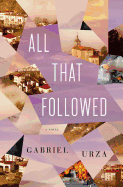
In Gabriel Urza's first novel, three narrators tell a nuanced story that meanders over three events in Spanish Basque political history. It centers on the fictional north coast town of Muriga, rocked in the 1930s by the violence of the Spanish Civil War, when Francisco Franco's Falangists assassinated local Republican supporters. In the late '90s, a local Muriga councilman was kidnapped and killed by young students affiliated with the separatist Euskadi Ta Askatasuna organization. In 2004, when All That Followed begins, 190 commuters have just been killed and 1,800 wounded in the Madrid Atocha train station bombing, initially rumored to be the work of the ETA but then attributed to al-Qaeda.
Muriga, where road signs are written in both Basque and Spanish and close-knit citizens keep their politics to themselves, is a town with secrets--both political and personal. Against this rich historical background, Urza's novel focuses on the effect that political violence has personally on those caught in its turmoil. It's the story of the world as it seems now--fragmented, politically unstable, violent--and the ways people find to cope.
Urza--Nevada public defender, Ohio State MFA graduate and descendent of a Spanish Basque family--writes clean prose, scattering Spanish and Basque words as he goes. All That Followed positions today's young generation in a place where the future can't outrun the past, and the present--with all its tangled loyalties, politics, attachments and detachments--is all there is. --Bruce Jacobs, founding partner, Watermark Books & Cafe, Wichita, Kan.