

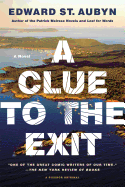
Edward St. Aubyn (Mother's Milk) calls A Clue to the Exit his favorite of his own novels. Originally published in 2000, it's now being reissued by Picador.
Charlie is a hack screenwriter who's just been told he has six months to live. He starts driving more carefully, even as he considers suicide, experimenting with the proper response to this news. He contacts his ex-wife about seeing his daughter; he sells his house and takes half his riches to Monte Carlo to lose it as quickly as possible. And, suddenly inspired, he sets out to write a serious novel--much to his agent's exasperation.
St. Aubyn's craft is on full display with this inward-looking work of simultaneous parody and earnestness. Nearly every line is quotable, a small but shining victory of prose. Charlie's novel, On the Train, visits with Proust and Buddha, while "a clue to the exit" references Henry James on "the human maze," but alongside serious, even wearying considerations, Charlie's story is often very funny and self-referential. A third-person narrative "is so much more personal than a first-person narrative, which reveals too flagrantly the imposture of the personality it depends on," writes St. Aubyn in Charlie's voice: A Clue to the Exit is told in first-person, while On the Train is in the third. This feedback loop is a central device. "Feeling too upset to write, I made the brave decision to write about feeling too upset."
A refined and stylish novel of cynicism and the question of death, A Clue to the Exit is a perfect sample of St. Aubyn's craft. --Julia Jenkins, librarian and blogger at pagesofjulia