

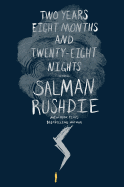
Two Years Eight Months and Twenty-Eight Nights has a lot in common with Salman Rushdie's best-known work, The Satanic Verses. Both begin with a miraculous event that turns the major characters into something more than human, and leads to a series of escalating circumstances that only those characters can stop. But while The Satanic Verses was a sprawling, blasphemous (to some), hulk of a book, Two Years Eight Months takes an entirely different tack, treating a battle for the fate of humanity with the lightest of touches.
After a superstorm hits New York, a group of individuals finds they have been granted special powers due to their lineage. Unbeknownst to them, they are the descendants of Jinn, fanciful spirits that once visited the earth on a regular basis but now keep to their own world. But with the storm comes a cabal of dark Jinn, happy to wreak destruction, and it is up to the rag-tag demigods and their Jinn ancestor to fend off the supernatural invasion.
As tense as that description sounds, Rushdie isn't much interested in Sturm und Drang. Instead, he uses Jinni and their descendants to plumb questions of what exactly makes us human. By creating a raucous, capricious species that represents a hyperbolic version of humanity in the Jinn, Rushdie argues for some of our smaller qualities (a dedication to work well done, to simple connections between people), and the most important human concept of all: love. In the hands of another writer, Two Years Eight Months would be a Michael Bay-esque battle across the world. Instead, Rushdie uses the apocalypse as a place for meditation. --Noah Cruickshank, marketing manager, Open Books, Chicago, Ill.