

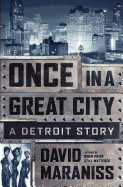
Once in a Great City, Pulitzer Prize-winning journalist David Maraniss's account of Detroit in the early 1960s, joins his They Marched into Sunlight and Rome 1960 to form what he calls a "sixties trilogy," exploring America's social and political history during that turbulent decade. This addition is a sobering portrait of a city that felt itself to be at the peak of its power and influence in a "time of uncommon possibility and freedom when Detroit created wondrous and lasting things," even as the forces that would topple it had set about their work.
The principal strength of Maraniss's book lies in his skill at marshaling copious research to serve his sophisticated account of a complex, vibrant city balanced on its tipping point. Detroit's economy in those days was propelled by a robust automobile industry that "gave blue-collar workers a way into the middle class" as it churned out full-sized cars while shrugging off early warnings of competition from the compact models of nimbler foreign competitors. Boasting a population approaching 1.7 million in 1960, Detroit soon faced the unintentionally destructive force of urban renewal and demographic realities like white flight, which would propel a population decline to barely 40% of that figure by the time the city filed for bankruptcy in 2013.
Recent developments give some reason to hope that, as it emerges from bankruptcy, a much smaller and humbler Detroit will rebound from the worst of its decline. Sadly, one can't avoid the conclusion that never again will it be the city David Maraniss portrays with empathy and candor in this impressive book. --Harvey Freedenberg, attorney and freelance reviewer