

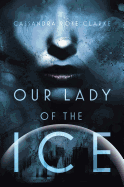
In Hope City--an Argentinian colony in Antarctica that produces nuclear energy for the mainland--not long after Last Night festivities (one evening of revelry before the citizens batten down for the long, cold winter to come), a woman of the aristocracy walks into Eliana's dingy office. Marianella Luna's business is delicate, she says. Like any PI worth her salt, Eliana responds that discretion is her specialty. Well known for her support of the independence movement, Marianella has come for help because some documents have been stolen from her home. Eliana takes the job, enticed by the exorbitant paycheck offered.
Cassandra Rose Clarke's Our Lady of the Ice has all the markings of a classic noir thriller: gangsters and PIs, corrupt politicians and femmes fatales, yet this is more than Raymond Chandler with a sub-zero setting. Marianella isn't human. She's a cyborg, a human-machine blend universally regarded as an abomination. There is a natural kinship between sci-fi dystopias and noir mysteries. They share a bleak view of human nature--these are tales where evil is chaotic and entropic, a feature of society rather than an aberration. All the characters, human and otherwise, are suffering from broken programming of one kind or another.
When everyone is at their worst, even the most fallen have a shot at redemption. In Our Lady of the Ice, Cassandra Rose Clarke (The Mad Scientist's Daughter) uses old tropes to their very best effect, showcasing the chilling wisdom of genre fiction at its best. --Emma Page, bookseller at Island Books in Mercer Island, Wash.