

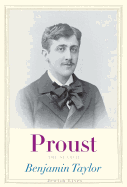
French novelist Marcel Proust believed that a writer's genius was in the ability to distill life into a single, simple story. In his biography Proust: The Search, Benjamin Taylor observes that Proust's genius was not in the way he distilled life, but in how he was able to re-create every bit of minutiae.
It has long been known that Proust's seven-volume masterpiece, In Search of Lost Time, is largely autobiographical. In it, a nameless narrator, referred to only once as "Darling Marcel" in the fifth volume, recounts his entire life. Proust treats each passing moment, no matter how mundane or fabulous, with equal emotional weight, recounting details with poetic flourish, and rooting events in both French history and his own life.
In Proust: The Search, Taylor expertly deconstructs where the similarities between Proust's fictional self and real-life self begin and end. By combing through both In Search of Lost Time and Proust's personal history, Taylor discovers which events in Proust's own life were most important to the young genius's creative development. Taylor outlines how French anti-Semitism during the Dreyfus affair affected the writer's Jewish identity and how Proust treated his semi-open homosexuality on the page.
Of a particular passage from In Search of Lost Time that was inspired by Proust's real love affair, Taylor writes that, "in the first blush of love for Reynaldo, Marcel did manage a premonitory truthfulness in which his mature understanding, if not the mature force of his style, may be glimpsed."
A deep analysis of Proust's masterpiece and a biography of Proust the man, Taylor proves, are one and the same. --Josh Potter