

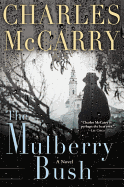
Charles McCarry has been writing international spy thrillers since the early 1970s, including The Shanghai Factor. A former CIA operative and now in his 80s, McCarry permeates his fiction with hands-on knowledge. The Mulberry Bush takes us inside the recruiting process, with its security-scrubbed data thumb drives and its field operatives with their burner phones, "assets" and nondescript hotel rooms, from which they send secrets back to Headquarters and arrange to take out high-level objectives.
The unnamed recruit of The Mulberry Bush has a knack for languages and a Ph.D. in Islamic history. His father was a renowned agent until the CIA tossed him for one too many renegade pranks, his career tanked, and he died homeless on the streets of D.C. The protagonist is determined to avenge his father and punish the Headquarters staff who destroyed him. After years in the Middle East proving his mettle ("where there are suicide bombers and boredom"), he is sent by Headquarters to Buenos Aires to infiltrate a disbanded former Communist terrorist cell and turn its local players. He does the job but also falls upside-down in love with Luz, the voluptuous daughter of the charismatic revolutionary leader who was killed by the agency. She readily joins his mission to bring down Headquarters.
McCarry's complicated plot, with lots of shadowy side players, drunks and mercenary thugs grinds slowly in the novel's middle, but the narrator's driven pursuit of revenge carries the day--that, and his near-priapic lust for Luz. A little Ian Fleming, a little Charles Cumming, a little Barry Eisler--McCarry is in fine company. --Bruce Jacobs, founding partner, Watermark Books & Cafe, Wichita, Kan.