

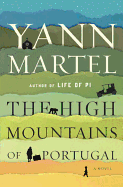
In The High Mountains of Portugal, Booker Prize winner Yann Martel (Life of Pi, Beatrice and Virgil) uses myth and fantastical elements to meditate on the relationships among death, faith and belonging in three interconnected stories. The first piece, titled "Homeless," takes place in 1904 and tells the story of Tomás, a young man shattered by the simultaneous loss of his lover, five-year-old son and father. He walks backwards, "his back to God," to protest his losses, and becomes obsessed with a mysterious crucifix described in a stolen 17th-century diary before undertaking a comical but emotionally charged journey to the mountains of Portugal to seek it.
In "Homeward," an old woman in 1938, bearing the body of her recently deceased husband in a suitcase, seeks closure by asking pathologist Eusebio Lozora to conduct an autopsy and assess how her husband lived. Reminiscent of the human-animal tale from Life of Pi, "Home" describes the 1981 journey of Canadian Senator Peter Tovy, who, after his wife's death, adopts a chimpanzee named Odo. His search for a new life in the mountains of Portugal reveals an unexpected thread that connects him to the historical past of "Homeless" and "Homeward."
With ingenious twists and turns, Martel's storytelling achieves his noble intentions: "It is together, in an act of imaginary consummation, that the story is born. This act wholly involves us, as any marriage would, and just as no marriage is exactly the same as another, so each of us interprets a story differently, feels for it differently." --Nancy Powell, freelance writer and technical consultant