

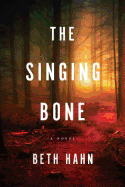
Beth Hahn's debut thriller, The Singing Bone, successfully fictionalizes and uses the Manson murders to tell the story of Alice Pearson, survivor of an infamous cult that committed unspecified atrocities in the late '70s. Hahn skillfully switches back and forth between 1979--when a 17-year-Alice fell under the sway of the very Manson-like Jack Wyck--and the present day, showing us two very different sides of Alice. Present-day Alice has changed her name and started a new, somewhat lonely life as a professor of folklore. An obsessive filmmaker, however, interrupts her refuge in academia when he tracks her down and forces her to reckon with Wyck and the demons of her past.
The Singing Bone is adept at explaining how cruel, charismatic individuals can bend men and women to their will by exploiting youthful insecurities as well as the universal desire to belong. Hahn takes a slow-burn approach to the events of 1979, letting circumstances turn sour and then dangerous so gradually that Alice and her drugged-out friends hardly notice until it's too late. Parallels with Charles Manson and the Family abound, to the point where it's not entirely clear why Hahn didn't choose simply to offer a fictional retelling of the events depicted so memorably in Helter Skelter. However, while the flashbacks reveal a familiar, if still gripping, narrative, present-day events are more unpredictable, offering a nightmarish glimpse into a world where Wyck's teachings have found a lasting, devoted audience. The Singing Bone is a convincing, skin-crawling descent into madness. --Hank Stephenson, bookseller, Flyleaf Books