

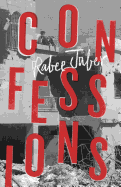
Rabee Jaber's Confessions is set during the Lebanese civil war, a confusing, factional, multi-party conflict waged in fits and starts from around 1975 to 1990. The narrator finds himself similarly confused, the fog of war seemingly settling over his own scattered recollections of the period. The key themes of memory and identity reveal themselves to be disquietingly fluid as the narrator anxiously interrogates his own soul.
Confessions is slim, and Jaber keeps the plot to a minimum. The novel opens brutally with the line, "My father used to kidnap people and kill them," but even that blunt admission does not disclose the full truth. The man the fitful narrator thinks of as his father is in fact the murderer of the narrator's real family--he massacred them as part of a Christian militia and kidnapped the narrator to replace his own young son, a child brutally murdered by a Muslim militia. From that initial premise, Jaber hops back and forth through time, following the erratic trail of memory: "Certain memories evoke certain other ones--they're joined by strings invisible yet real." Confessions is about the narrator coming to terms with this violent adoption: the revelation shatters his sense of identity in a world fraught with sectarian divides, including the demarcation line that splits Beirut in half.
Jaber has fashioned an achingly beautiful coming-of-age story, both for his narrator and for a generation of Lebanese forced to try to craft a national identity out of a murky past. --Hank Stephenson, bookseller, Flyleaf Books